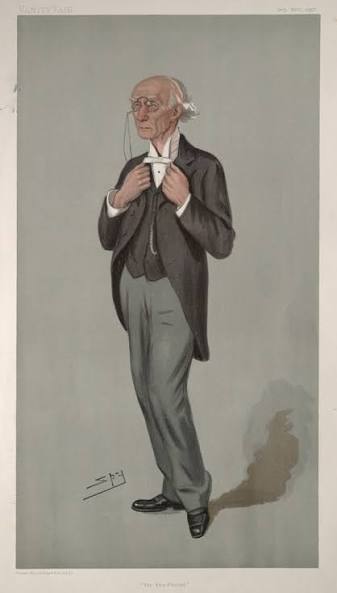
 Francis Warre Warre-Cornish (May 8, 1839 – August 28, 1916) was a prominent British schoolmaster, classical scholar, librarian, and author.
Queer Places:
Eton College, Windsor, Windsor and Maidenhead SL4 6DW
University of Cambridge, 4 Mill Ln, Cambridge CB2 1RZ
Eton College Chapel, Eton, Windsor and Maidenhead Royal Borough, Berkshire, England
Francis Warre Warre-Cornish (May 8, 1839 – August 28, 1916) was a prominent British schoolmaster, classical scholar, librarian, and author.
Born in Bakewell, Derbyshire, he was the son of the Reverend Hubert Kestell Cornish and Louisa Warre. He received his early education at the prestigious Eton College, after which he went on to King's College, Cambridge, where he distinguished himself academically.
Warre-Cornish spent the vast majority of his professional life tied to Eton College. He returned to the institution as a master in 1861 and served the school for decades. In 1893, he was appointed Vice-Provost of Eton, a position he held until shortly before his death in 1916. Aside from his administrative and teaching duties, he was a prolific writer, publishing historical biographies, translations of classical poetry (such as the poems of Catullus), novels (including Sunningwell), and works on church history.
In 1878, he married Blanche Ritchie, a woman widely celebrated in elite literary circles for her sharp intellect, conversational brilliance, and eccentricities. Together, they had several children, including Mary ("Molly") MacCarthy—who became closely linked with the Bloomsbury Group—and Gerald Warre-Cornish, a scholar and author.
During his time at the University of Cambridge, Warre-Cornish was inducted into the elite and secretive intellectual society known as the Cambridge Apostles.
Founded in 1820, the Apostles functioned as an exclusive debating and conversational society for high-achieving undergraduates and select dons from Trinity College and King’s College. The society prioritized absolute freedom of thought, radical open-mindedness, and the unreserved pursuit of truth, allowing members to question orthodoxies spanning religion, politics, and philosophy. Membership in the Apostles deeply influenced Warre-Cornish’s intellectual development, connecting him to a tight-knit network of Victorian thinkers and writers that shaped his career in academia.
While Francis Warre-Cornish lived a conventionally married life and fathered children, his life and work intersect with Victorian and Edwardian LGBTQ+ history in several notable ways, primarily through his close associations, mentorship networks, and editorial work:
Warre-Cornish was a close friend and literary executor of William Johnson Cory (formerly William Johnson), the influential Eton master and poet who wrote Ionica. Cory was forced to resign from Eton in 1872 due to intense scrutiny over his intense, romantic emotional attachments to male pupils—a classic representation of Victorian "pederastic Hellenism" common in public schools. In 1897, Warre-Cornish edited and published Extracts from the Letters and Journals of William Cory, preserving his legacy.
As a master and later Vice-Provost of Eton during the late 19th century, Warre-Cornish operated at the epicenter of a British public school system heavily invested in classical Greek ideals of male mentorship and homosocial bonding. This environment frequently nurtured figures who later formed the backbone of early British homosexual literature and rights advocacy.
Through his daughter Mary's integration into the Bloomsbury Group, Warre-Cornish's family line bled directly into a cultural circle that pioneered early-20th-century challenges to traditional Victorian sexual mores, rigid gender roles, and heteronormativity.
References:
Support this project
This website is a passion project researched, developed, and funded entirely by me. If you find the content valuable and would like to help support the ongoing research and hosting costs, any contribution is deeply appreciated.
Thank you for keeping this independent resource alive!
My books on Amazon: Elisa Rolle's books